


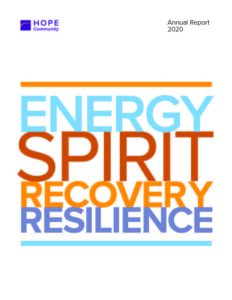
2020 Annual Report
Our 2020 Annual Report is a representation of a year that pulled this community together in unexpected ways. It is an honor share our stories of energy, spirit, recovery, and resilience, made possible by each and every one you. Your generosity, your advocacy, your trust, and your dedication to community is what keeps Hope strong.
Thank you for being a part of our Hope family, and for your hand in creating resiliency in community.
With profound gratitude,
Shannon Smith Jones
Staff Spotlights
Since mid-March, Hope’s staff has been working from home. We are adjusting our work and overcoming the challenges presented, and though our work today looks much different than it has during our previous 42 years, we are still fulfilling our mission each day. We are highlighting our staff members so you can hear from us how we fulfill our mission in today’s world! You’ll hear what our work looks like, what challenges we’re overcoming, what updates we have, and our plans moving forward. Thank you for joining us!
Youth & Family Engagement
Parks & Power Team
Malyun Yahye
ARC Team
Maryan Abdinur
Maggy Otte
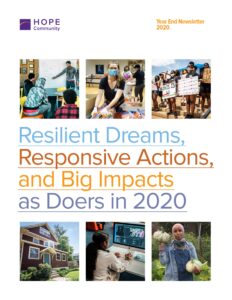
2020 Year End Newsletter
Please enjoy our Year End Newsletter to read about our resilient dreams, responsive actions, and big impacts as doers in 2020. We’re so grateful to have been in community with you all this year, and appreciate you for keeping Hope strong!
Archives
Feed the Roots: A Hope Community Listening Project Report
December 1, 2015
Feed the Roots is a two-year Hope Community Listening Project that involved more than 400 Phillips Community residents in dialogues about food, land, health, culture, and justice. This project continued Hope’s tradition of community dialogues around powerful questions, lifting up community voices to guide Hope’s work with and for the community.
Hearing the Call – Community Listening at Hope Community
Kate Tilney
January 1, 2008
Hope has become known for our Community Listening which has involved over 1,500 people in community dialogues. Community Listening emphasizes the importance of relationships and partnerships and it allows us to translate voices into action and better harness the collective power of people for change.
Hope Community Youth Listening Project Report
Hope SPEAC youth leaders
January 1, 2008
Hope youth leaders ventured into the community surrounding Hope in search of organizations and institutions that played vital roles in young people’s daily lives. They went to churches, schools, parks, shelter, and libraries. They talked to program coordinators, teachers and students. Through their work and commitment, SPEAC leaders brought small groups of youth together to dialogue about their dreams, challenges and fears.
Listening to the Community: A Park Designed Through Dialogue
Mary Keefe, Hope Community
May 1, 2005
Community: Taking a Closer Look
Hope Community Listening Report
April 1, 2001
In about 30 dialogues, over 300 people – youth, adults, elders, people from diverse culture traditions – discussed the meanings, pride and struggles they experience in their communities and neighborhoods.
New Minneapolis apartments fuse energy efficiency with style, affordability
Jim Buchta
Star Tribune
July 20, 2015
July 20, 2015
Hope Community: McKnight Foundation Impact Story
McKnight Foundation
May 27, 2015
May 27, 2015
10 development projects that will transform Minneapolis-St. Paul in 2015
Phillip Koski
MinnPost
December 12, 2014
December 12, 2014
A Place People Call Their Own: Community Partnerships That Foster Community Health
Jay Walljasper
The Line
December 10, 2014
December 10, 2014
Power of Vision’s Mural Unveils Community Perspectives
Adjoa Akofio-Sowah
Neighborhood Development Center
August 21, 2013
August 21, 2013
Duets: Jordan and Aaron, reading with a special touch
Gail Rosenblum and Jim Gehrz
Star Tribune
March 18, 2013
March 18, 2013
Hope Community in Minneapolis: Two tutors, two stories
Ge Gao
Twin Cities Daily Planet
December 10, 2012
December 10, 2012
From freeway to gateway: Hennepin County plan would reduce lanes on Park, Portland
Drew Kerr
Finance & Commerce
August 27, 2012
August 27, 2012
Not your typical gang of youth spray-painting inner-city Minneapolis walls …
Erin Collins
Twin Cities Daily Planet
August 9, 2012
August 9, 2012
MN Original: Chaka Mkali
TPT
June 13, 2012
Hope staff member Chaka Mkali and participants of the Power of Vision Mural Program were featured in TPT’s weekly arts series “MN Original”, celebrating Minnesota’s creative community.
Homes for All
Twin Cities Public Television
February 19, 2012
February 19, 2012
This is an excerpt from Homes for All, an in-depth look at current issues around affordable housing and the vast need for sustainable housing choices. Hope Community was one of three housing organizations profiled in this hour-long documentary. Co-produced with MN Housing Partnership.
Around the Nation
Saskia De Melker
PBS Around the Nation: Art Beat
December 15, 2011
December 15, 2011
Four arts and culture videos from public broadcasting partners were selected from around the nation and posted on the PBS art blog. Chaka M’kali of Hope Community was one of them. TPT’s Minnesota Original profiled M’kali’s murals, which he uses to tell stories that speak to the community, begin public discourse and inspire hope.
Hope Community on the Peter Mclellan Show – AM 1570
The Peter Mclellan Show
April 12, 2011
April 12, 2011
Finding freedom on two wheels: Community Partners Bike Library empowers low-income adults
Karen Hollish
TC Daily Planet
August 26, 2010
August 26, 2010
Organizers say bike rental program for low-income adults a success
Minnesota Public Radio
August 26, 2010
August 26, 2010
Interest in Solar Thermal Energy Heating Up
Stephanie Hemphill
Minnesota Public Radio
August 19, 2010
August 19, 2010
Minnesota Success Stories: Solar Hot Water for Apartments
Office of Energy Security, Minnesota Department of Commerce
March 22, 2010
March 22, 2010
Hope Community Trains Youth to Organize for Change
Vickie Evans- Nash
Minnesota Spokesman Recorder
September 14, 2007
September 14, 2007
There’s Hope for a Better Franklin Ave: A winning strategy for neighborhood stabilization
Minneapolis Star Tribune
September 1, 2007
September 1, 2007
Franklin Portland Gateway – The Jourdain awarded Best in Real Estate
Minneapolis/St. Paul Business Journal
April 23, 2006
April 23, 2006
South Minneapolis ‘wasteland’ sprouts new development
Dan Olson
Minnesota Public Radio
November 17, 2004
November 17, 2004